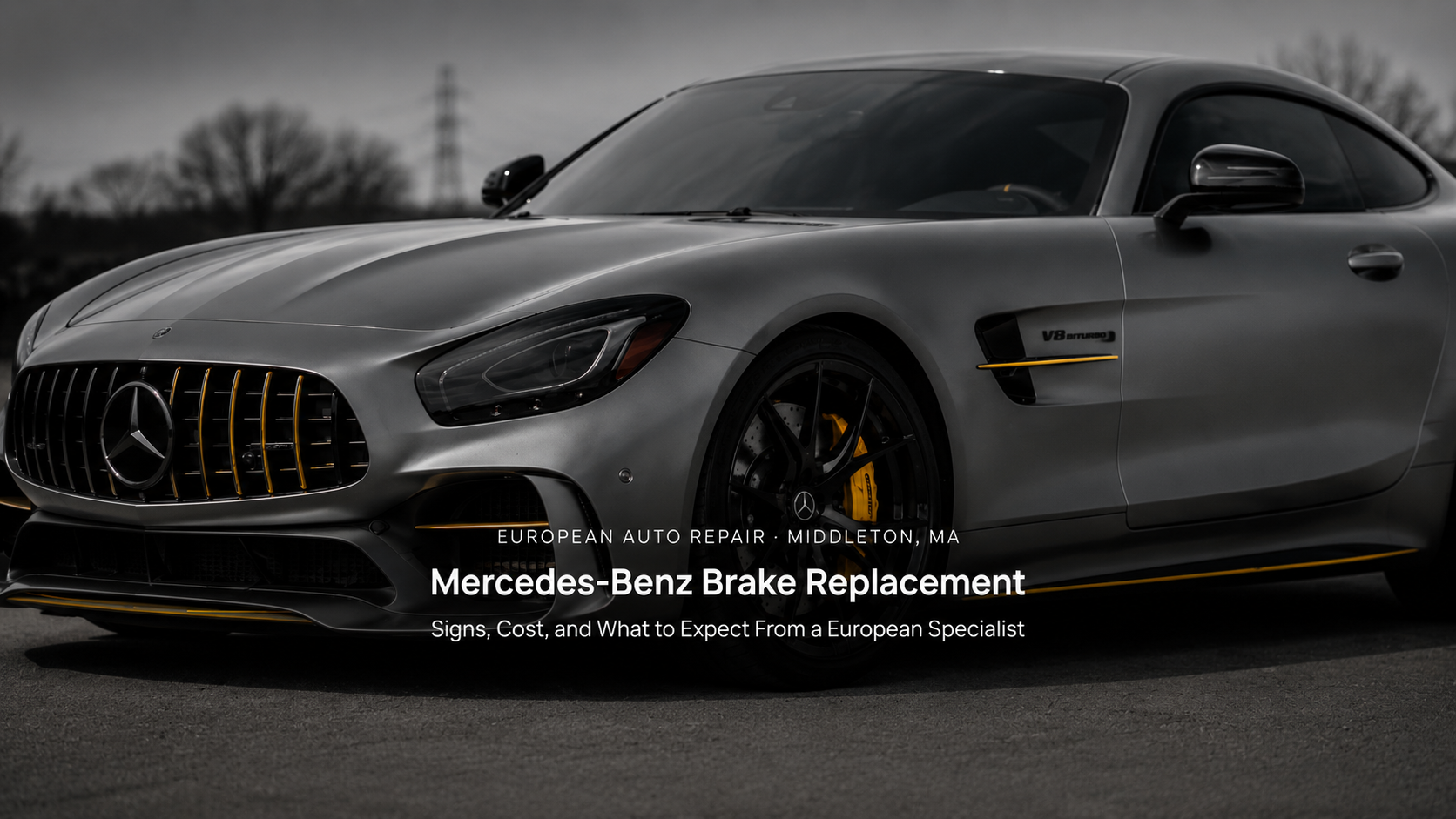
Mercedes-Benz brake replacement is one of the most important maintenance services you can stay on top of as a European car owner. Mercedes vehicles are engineered for exceptional stopping power, but that performance depends on quality parts, proper installation, and the right expertise. This guide covers the warning signs, what the service involves, and what to expect when you bring your Mercedes to a specialist.
Why Mercedes Brake Systems Are Different
Mercedes-Benz uses high-performance braking components that are engineered to work as an integrated system. The pads, rotors, and calipers are designed to specific tolerances — and when one component is replaced with a non-OEM or low-quality part, it can affect the performance and longevity of the entire system.
Most Mercedes models also include electronic brake wear sensors built into the pads. These sensors communicate directly with the vehicle’s on-board computer, triggering a dashboard warning when the pads reach a critical wear level. After replacing the pads, those sensors need to be reset using Mercedes-compatible diagnostic software — something a general shop may not have.
AMG and performance variants add another layer of complexity, often running larger rotors, multi-piston calipers, and compound pads that require even more precision to service correctly.
Signs Your Mercedes Needs Brake Replacement
The most obvious sign is a brake wear warning light on your dashboard. Mercedes is good about surfacing this early, giving you a reasonable window to schedule service before pads are fully depleted.
Beyond the warning light, pay attention to these signs:
- Squealing or squeaking when slowing down — often the wear indicator making contact with the rotor
- Grinding or metal-on-metal sound — pads are gone and rotors are being damaged
- Vibration or pulsing through the brake pedal — usually a sign of warped or uneven rotors
- Longer stopping distances or a soft, spongy pedal feel
- Pulling to one side under braking — could indicate uneven pad wear or a stuck caliper
Any one of these symptoms warrants an inspection. A Mercedes driving on worn brakes doesn’t just compromise your safety — it can lead to rotor damage that turns a straightforward pad replacement into a significantly more expensive repair.

How Brake Wear Happens in Mercedes Vehicles
Brake pads wear down gradually through friction every time you apply the brakes. In normal driving conditions, Mercedes brake pads typically last between 30,000 and 60,000 miles. That range shifts significantly based on driving habits, traffic, and terrain.
City driving and frequent stop-and-go traffic accelerate pad wear considerably. Driving in hilly areas adds additional stress on the braking system. Front brakes also tend to wear faster than rear brakes because they absorb more of the stopping force under hard braking.
Rotors can become worn, scored, or warped over time, especially if worn pads are left in service too long. Once rotor thickness falls below the minimum spec, replacement is required regardless of surface condition.
What Happens If You Ignore It
Ignoring brake wear on a Mercedes is one of the more costly mistakes an owner can make. Once the pads wear completely through, the metal backing plate contacts the rotor directly. This damages the rotor surface quickly — often requiring full rotor replacement rather than just a pad swap.
In severe cases, brake fluid can overheat from the increased friction, reducing braking effectiveness significantly. A compromised braking system also affects the vehicle’s stability control and ABS systems, which rely on consistent brake performance to function correctly.
What starts as a $400 pad replacement can easily become a $1,000+ repair if left too long. Addressing it early is always the better call.
What the Mercedes Brake Replacement Process Looks Like
A proper Mercedes brake service starts with a full inspection of the entire braking system — pads, rotors, calipers, brake lines, and fluid. This gives a clear picture of what actually needs to be replaced versus what’s still serviceable.
Pads and rotors are replaced in axle sets (both front or both rear) to ensure even braking. New brake wear sensors are installed with the pads. Calipers are inspected for proper operation and cleaned or replaced if needed.
Once the hardware is in place, the brakes are bedded in and the vehicle’s computer is reset using Mercedes-specific diagnostic software to clear any fault codes and reset the wear indicator. The system is then road-tested to confirm everything is functioning correctly before the car goes back to the customer.
For comprehensive Mercedes repair and maintenance services, North Shore Motor Werks handles everything from routine brake service to complex diagnostics.
How Much Does Mercedes Brake Replacement Cost?
The cost of Mercedes brake replacement depends on which axle needs service, the model, and which components require replacement. Front brake pad and rotor replacement typically runs less than a full four-wheel service. AMG and high-performance variants cost more due to the larger, more specialized components involved.
At a Mercedes dealership, brake service can be significantly more expensive than at an independent European specialist offering the same quality parts and expertise. North Shore Motor Werks uses OEM-grade components and backs all brake work with a 3-year / 36,000-mile warranty — giving Mercedes owners dealership-level quality without the dealership price.
If you’re comparing options for European auto repair in Middleton, MA, the combination of factory-trained technicians and a strong warranty makes a specialist shop the smart choice.
Schedule Your Mercedes Brake Replacement in Middleton, MA
If you’re hearing brake noise, seeing a warning light, or just want to know where your brakes stand, the best next step is an inspection. Catching brake wear early keeps the repair straightforward and protects your rotors from unnecessary damage.
North Shore Motor Werks serves Mercedes owners throughout Middleton, Peabody, Salem, Beverly, Danvers, Andover, and the surrounding North Shore area. Same-day service is available, and loaner cars can be arranged to keep you moving while your vehicle is in the shop.
Schedule your brake service online or give the team a call at 978-531-0007. You can also reach out with any questions before booking — the team is happy to walk you through what to expect.
About the Shop
North Shore Motor Werks — Euro Specialists Backed with Integrity & Value
Founded in 2013 by James Hart — a BMW Master Technician and USMC veteran with over 20 years of experience — North Shore Motor Werks is Middleton, MA’s premier destination for European auto repair. James and his team of factory-trained technicians specialize in BMW, Mercedes-Benz, Audi, Volkswagen, Porsche, and MINI, with the equipment, software, and expertise to handle everything from routine maintenance to complex diagnostics. Every repair is backed by a 3-year / 36,000-mile warranty, and the shop offers loaner vehicles, ride-share reimbursement, and same-day service to make the experience as easy as possible. If you drive a European vehicle on the North Shore, this is your shop.
Follow Us on Instagram
@northshoremotorwerks
Behind-the-scenes, shop updates, and European car content — follow along for more.
Frequently Asked Questions
How much does Mercedes brake replacement cost?
The cost varies depending on which axle needs service, your specific model, and which components require replacement. Front pads and rotors typically cost less than a full four-wheel service. AMG models with larger braking systems run higher. At an independent European specialist like North Shore Motor Werks, you’ll get OEM-quality parts and workmanship at prices that are competitive with dealership service.
How often should Mercedes brakes be replaced?
Brake pads on a Mercedes typically last 30,000 to 60,000 miles depending on driving habits, traffic, and terrain. City driving and frequent braking will wear pads faster. Your vehicle’s brake wear sensors will alert you on the dashboard when it’s time for service — don’t ignore that warning.
Can I drive my Mercedes with the brake warning light on?
You can drive short distances carefully, but it’s not recommended to continue normal driving with an active brake warning. The light typically means your pads are near the end of their service life. Continuing to drive risks rotor damage, which turns a straightforward pad replacement into a much more expensive repair.
Do Mercedes rotors need to be replaced with the pads?
Not always — it depends on the rotor’s thickness and surface condition. If the rotors are within spec and the surface is clean, pads alone can be replaced. If rotors are worn, scored, or warped, replacing them at the same time as the pads is the right call and saves labor cost down the road.
What’s the difference between getting brakes done at a dealership vs. a specialist shop?
A Mercedes-Benz dealership uses factory parts and trained technicians, but typically charges a significant premium for labor and parts markup. An independent European specialist like North Shore Motor Werks uses the same quality OEM-grade components and Mercedes-compatible diagnostic software, with lower overhead and often faster turnaround — plus a 3-year / 36,000-mile warranty that matches or exceeds what you’d get at the dealer.